
What a Hostile Termination Might Reveal About Your Workplace Violence Plan
There is rarely a week that goes by without a familiar message popping up in one of the security networks:
“URGENT! Request for Services: Armed guard needed for hostile termination. 3 days coverage. Starts tomorrow.”
Last-minute request.
Three days of armed coverage.
Starting tomorrow.
That’s the plan.
And it causes me significant discomfort. Every. Single. Time.
Why? Because I’ve done hundreds of threat assessments. I’ve spent hours, armed, in company lobbies and parking lots, waiting to see what happens. And I can tell you three things for sure:
Hostile terminations rarely come out of nowhere.
Inviting a potential armed confrontation to your property is a recipe for tragedy.
The troubles of troubled people don’t expire on Day Four.
Hostile Terminations Can Be a Symptom of a Larger Problem
So let’s be honest. If you need an armed guard to fire someone, something has goneterribly wrong. And your workplace violence plan may be part of what’s wrong.
Worse still, the last-second scramble for armed guards is poor crisis management.
Risking a gunfight on company property?
Your lobby or parking lot isn't the O.K. Corral.
What’s the plan for Day Four and beyond?
Because the risk doesn’t end when the guard goes home.
Are you inviting a gunfight to your lobby or parking lot?
Effective Plans Prevent Violence Before it Starts
Effective workplace violence prevention plans help identify and address issues early. And most issues are manageable with time and skill on your side – before they become a crisis. They create a framework that supports and fosters a culture of safety. And they do this by leveraging your most important asset: people.
Here’s what that looks like in practice:
Safe ways to speak up early. This includes options for confidential reporting, managers who listen well, and support for personal or work issues before they worsen.
A standing threat assessment team. A group that meets on a consistent basis, understands risk indicators and knows what actions to take — whether the concern involves an employee, customer, contractor, or someone’s partner.
Training that sticks. Educating the entire workforce about the warning signs, how to report them, and what to expect. That includes vendors and anyone else who is part of the workplace – especially your security vendors.
Smart ways to lower risk. Including early help for employees who are struggling, support for domestic violence victims, and flexible exit strategies when it's time for someone to separate.
Multi-disciplinary threat assessment team meeting to evaluate a "person of concern"
Workplace Violence Isn’t Just a Problem Employee Issue
The gunman who recently took hostages at UPMC Memorial Hospital in Pennsylvania was not an employee. He was a grieving husband.
49-year-old Diogenes Archangle-Ortiz reportedly became agitated and confrontational about his wife's terminal diagnosis. Hospital staff ejected him. He returned the next day and killed a police officer and injured five others.
I’m certain UPMC has a workplace violence policy.
Yet, despite the hospital's awareness of the confrontation, Archangel-Ortiz was still able to take hostages and commit murder the very next day.
Would a stronger workplace violence plan have prevented this tragedy? We can only speculate.
But in retrospect, there were likely opportunities to avoid the tragedy:
Ejecting Archangel-Ortiz may have escalated the situation. A trauma-informed response with support might have helped prevent it.
It's unclear whether staff recognized the risk he posed. If they had, proactive security measures might have prevented or limited the violence.
Good policies don’t guarantee good outcomes. But they give you a fighting chance to prevent a tragedy.
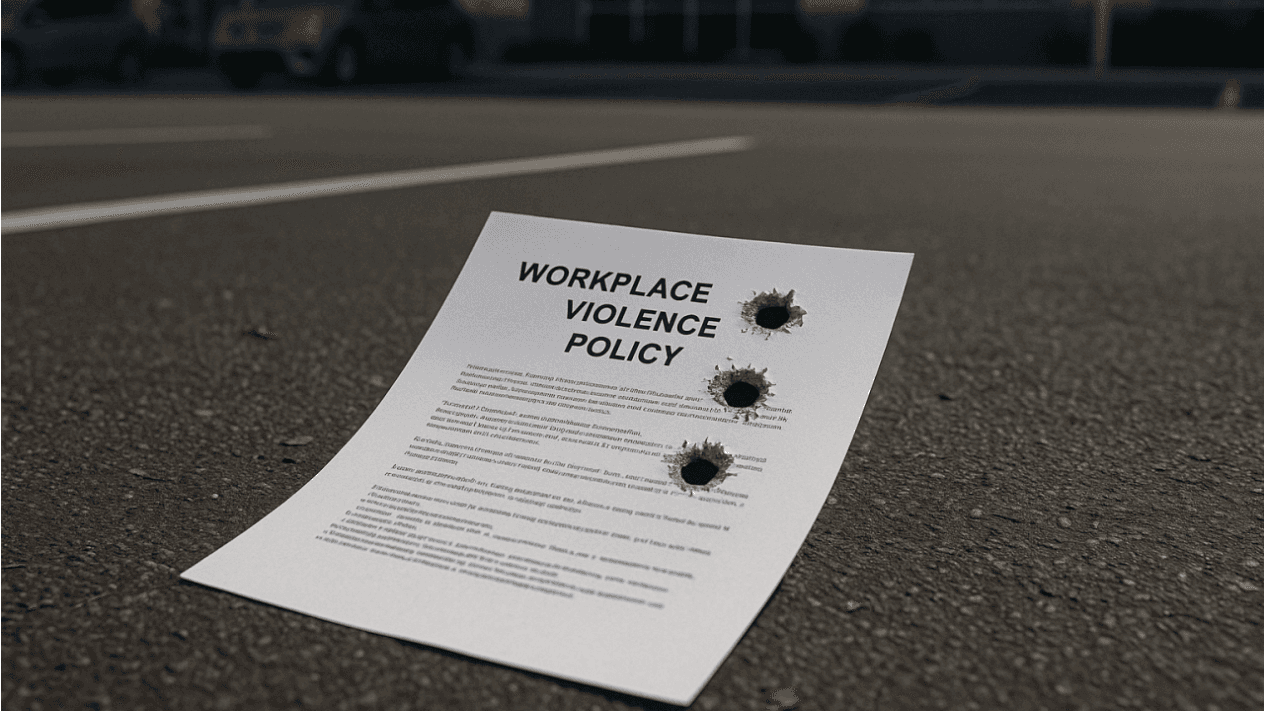
Do You Have a Plan, or Just a Piece of Paper?
We recently conducted a security assessment for an organization. They had excellent leadership, good physical security, and well-written policies and procedures.
Except for their workplace violence prevention plan. It was more policy than plan. A basic document that met a state requirement but lacked the elements proven to prevent violence.
The policy existed only to satisfy a mandate. A mere piece of paper waiting to be produced upon demand.
And paper doesn’t stop violence. A culture of safety and trained people do.
Ask any survivor of domestic violence about restraining orders. They'll tell you—a piece of paper doesn’t stop bullets.
"Just a piece of paper"
If Your Plan Doesn’t Account for Domestic Violence, It’s a Liability
Threats to kill. Harassment during work hours. Stalking. Victims afraid to report — fearing embarrassment, retaliation, or job loss. Abusers trying to get them fired.
Restraining orders violated.
A campaign of terror.
And then one day, a dangerous abuser shows up at the workplace.
According to research:
An estimated 27% of workplace violence stems from domestic violence. And up to 74% of those affected experienced harassment from a partner while working.
Yet, most organizations still don't have a formal domestic violence policy.
I work with over 900 victims each year, and most of those employed face risk at work.
Domestic violence is so common that someone in your organization is likely facing it right now. That means the risk is already in your building — or it’s coming.
Is your organization ready?
An effective workplace violence prevention plan should provide victims with:
Employment protections and flexibility.
Confidential reporting pathways.
Domestic violence-informed EAP and HR support.
Managers trained to respond competently to domestic violence.
A threat assessment team that understands domestic violence risk factors.
A plan that ignores the source of more than a quarter of all workplace violence isn't a plan. It's a liability.
And a plan that doesn’t protect victims empowers abusers.
Most Organizations Wait Until It’s Too Late
In 2020, the National Safety Council reported more than 20,500 injuries due to workplace violence. 400 of those incidents were fatal.
The average out-of-court settlement? Around $500,000. And jury awards can be much higher—sometimes in the millions.
The risk of violence is a persistent presence in our lives. Still, most people wait until something bad happens before they act.
It’s human nature.
It’s why more than half of self-defense students enroll after experiencing victimization.
Most organizations are no different. They’re made up of people. So, they usually wait too.
But proactive organizations don't wait for tragedy to strike before acting.
They assess. They plan. And they prepare.
“An ounce of prevention is worth a pound of cure.” - Benjamin Franklin
Assessing your workplace violence plan today can prevent a tragedy tomorrow. It's a proverbial ounce of prevention. It also costs less than armed guards, lawsuits, and rising insurance costs.
Partner with Omnium
At Omnium, we help organizations of all sizes assess and improve their readiness to prevent workplace violence. We help organizations develop policies, deliver training, and strengthen their risk and threat assessment capabilities. Whether you are building a program from scratch or enhancing what is already in place, we can help.